Commission Cycle 2026: How Mark Ling’s Commission Cycle Method & System Works
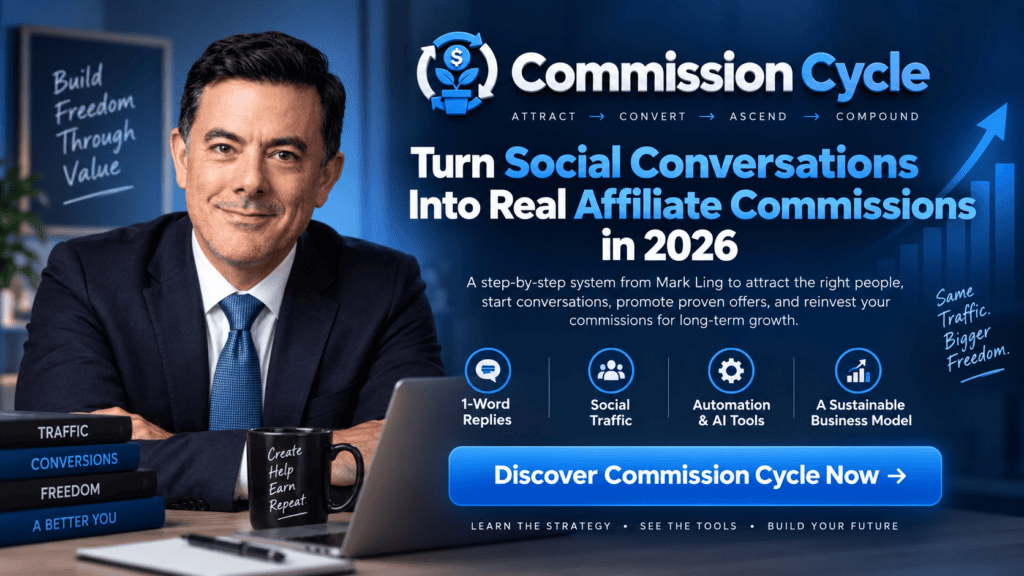
Commission Cycle is Mark Ling’s 2026 affiliate marketing system built around a simple idea: generate affiliate commissions, reinvest part of those profits into the part of your business most likely to grow next, and repeat the process.
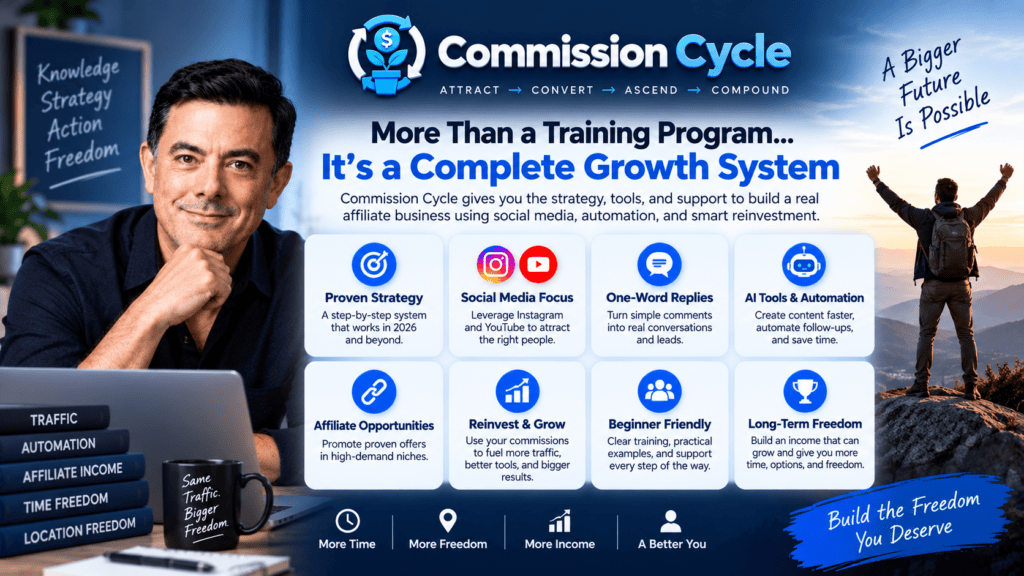
Instead of depending on one traffic trick, the Commission Cycle Method combines social media traffic, one-word replies, affiliate offers, automation, AI-powered content tools, and a four-stage growth model:
Attract → Convert → Ascend → Compound
The current strategy focuses primarily on Instagram and YouTube, with ManyChat automation and specialized AI tools helping handle much of the repetitive work behind research, posts, scripts, videos, and images.
And no, the underlying idea isn’t simply “post videos and hope they go viral.”
The bigger concept is what happens after you make the first commission.
Rather than taking the money and starting from zero again, Commission Cycle teaches you to put a portion of that profit back into whichever part of the business can most efficiently produce the next result.
That is why Mark calls it a cycle.
Commission Cycle at a Glance
| Detail | Commission Cycle |
|---|---|
| Product | Commission Cycle |
| Creator | Mark Ling |
| Main Focus | Affiliate marketing and commission scaling |
| Core Method | Attract → Convert → Ascend → Compound |
| Primary Traffic | Instagram and YouTube |
| Lead Strategy | Social posts, short videos and one-word replies |
| Automation | ManyChat + purpose-built AI tools |
| Main Niches | Personal development and make-money-online |
| Experience Needed | Designed to include beginners |
| Product Creation Required? | No |
| Large Email List Required? | No |
| Current Price | $2,497 |
| Payment Option | 6 payments of $497 |
| Free Training | Profit Engine Live |
| Creator Experience | Online marketing since 1999 |
Want to see the Commission Cycle offer directly from the authorized source?
What Is Commission Cycle?
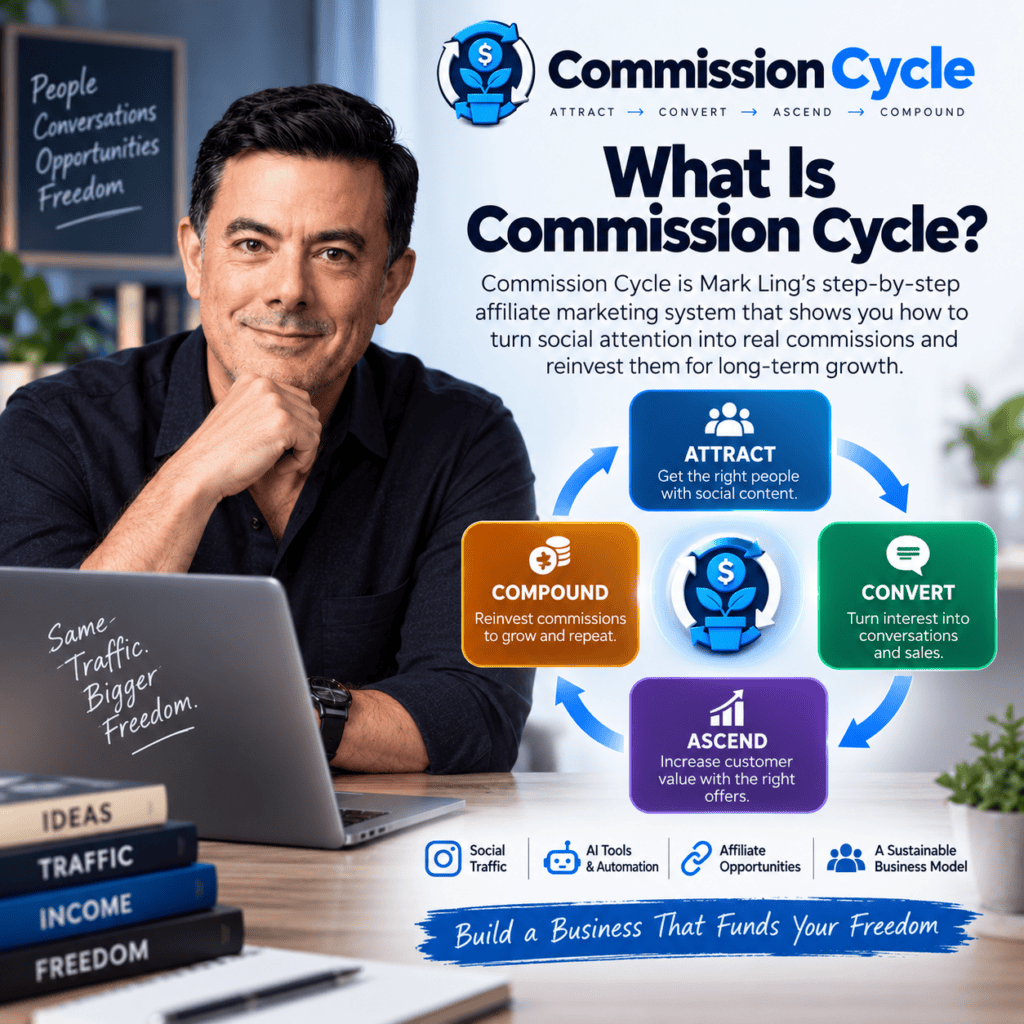
Commission Cycle is a premium affiliate marketing training program created by longtime online marketer Mark Ling.
At the surface level, it teaches people how to generate affiliate sales using social media.
But describing it only that way misses the more interesting part.
Plenty of courses teach Instagram.
Others teach YouTube, funnels, automation, AI content creation or affiliate marketing.
The Commission Cycle system tries to connect those pieces around a business principle that can survive individual traffic platforms.
In simple terms:
Traffic → Leads → Sales → Commissions → Reinvestment → More Traffic → More Sales
Think of it like pushing a flywheel.
The first few turns require effort. You create content, generate responses, recommend relevant products and try to make the first sales.
Once money starts coming into the business, however, part of that money can be used to create additional momentum.
Maybe traffic is currently the bottleneck.
Maybe enough people are arriving but too few are converting.
Perhaps customers buy once but there is an opportunity to recommend something else genuinely useful later.
Commission Cycle teaches students to identify that constraint and work on it rather than randomly jumping from tactic to tactic.
That distinction matters.
The biggest mistake people make in affiliate marketing is often not a lack of information.
It’s having too much disconnected information.
One week they’re learning Instagram.
Next week they’re trying paid ads.
Then an AI tool appears.
Then somebody recommends a new funnel.
A month later, they’ve spent plenty of money but still don’t know which number inside their business actually needs improvement.
Commission Cycle attempts to replace that behavior with a repeatable system.
How Does the Commission Cycle Method Work?
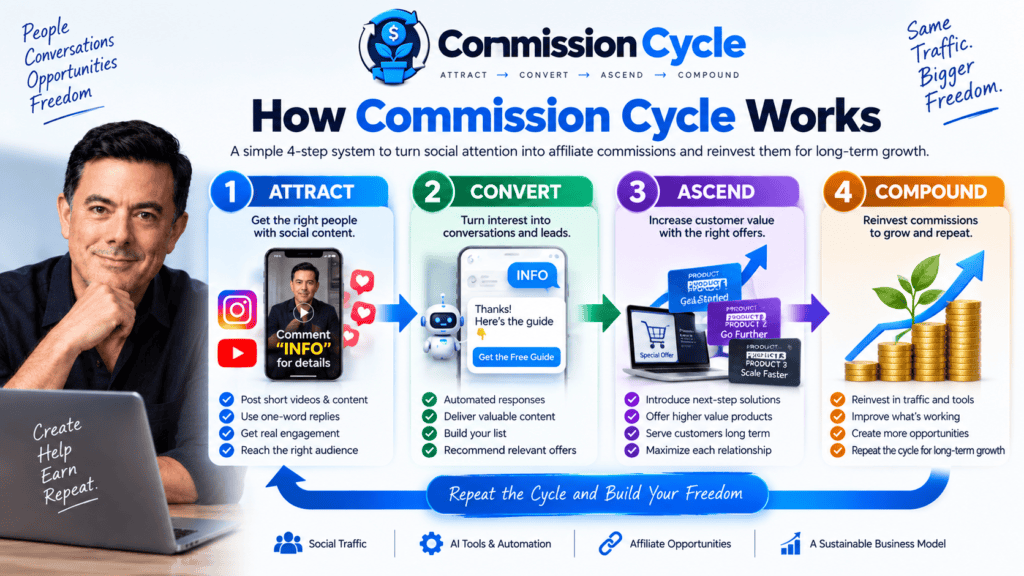
There are two useful ways to understand the Commission Cycle Method.
The first is the customer-facing cycle:
1. Attract
The first job is getting the attention of people who may genuinely be interested in what you’re promoting.
The current Commission Cycle strategy puts considerable emphasis on short social content.
Instead of assuming that success requires millions of views or an enormous account, the training looks for something more meaningful:
a response.
One of the main strategies involves posts designed to generate simple, often one-word replies.
Why does that matter?
Because a comment such as:
“Guide”
“Yes”
or
“Interested”
may tell you more about somebody’s intent than 1,000 passive views.
A person who actively responds has raised their hand.
That’s where the next stage begins.
2. Convert
The reply can trigger the next part of the process.
Automations such as ManyChat can help deliver a resource or continue the interaction without requiring someone to manually respond to every comment.
The goal isn’t to immediately bombard people with affiliate links.
It’s to move an interested person from a public social interaction into a more useful conversation or resource.
From there, relevant affiliate products can be introduced.
You recommend somebody else’s product.
If the visitor purchases through your affiliate link, you receive a commission.
That means you don’t have to manufacture the product yourself, manage inventory or create a customer-support department around your own offer.
3. Ascend
Here’s where the model moves beyond chasing isolated commissions.
A customer who buys one relevant solution may eventually need another.
For example, imagine someone interested in improving productivity.
Their first purchase might solve time management.
Later they could reasonably be interested in goal setting, mindset, business productivity or another complementary solution.
This is why Commission Cycle puts emphasis on increasing customer value rather than treating every affiliate sale as the end of the relationship.
The goal should never be to recommend random products simply because they pay a commission.
Good affiliate marketing works when the next recommendation makes sense for the person receiving it.
4. Compound
This is the part that gives Commission Cycle its name.
A portion of the commissions generated by the business can be reinvested into growth.
And here’s what most people don’t know: reinvesting doesn’t necessarily mean immediately buying advertisements.
It might mean investing in:
- additional traffic,
- better organic content,
- stronger conversion assets,
- automation,
- audience-building resources,
- or something else that improves the economics of the business.
You are effectively using profits generated by the business to help finance its next stage.
Then the process repeats.
Attract → Convert → Ascend → Compound → Attract again.
The Four Numbers Behind the Commission Cycle System
There is another layer underneath the Attract–Convert–Ascend–Compound framework.
Mark breaks profit growth down into four main levers:
Leads × Conversions × Average Dollars Per Sale × Average Number of Sales Per Customer
This is one of the most useful ideas inside the overall Commission Cycle concept because it forces you to look at the business mathematically rather than emotionally.
Imagine two affiliate marketers.
The first keeps searching for new strategies every time income slows down.
The second asks:
Which of my four numbers is currently weakest, and which one can I improve most economically?
Those are very different approaches.
Suppose traffic is already strong but conversions are poor.
Buying even more traffic might be wasteful.
Improving the conversion process could be considerably more valuable.
Or perhaps conversions are healthy but the business has too few leads.
Then additional traffic or more organic content might deserve the investment instead.
This is what makes the Commission Cycle Method more interesting than a single social media tactic.
Platforms can change.
The four underlying business numbers still matter.
The One-Word Reply Strategy Explained
One-word replies are currently one of the most visible entry points into Commission Cycle.
Let me explain why the idea is attractive.
Traditional social media advice tends to obsess over reach:
How many followers?
How many views?
How many likes?
But none of those numbers automatically mean somebody wants what you’re recommending.
Commission Cycle shifts some of that attention toward intent.
Imagine you publish a short Instagram post about a simple morning productivity framework and end with:
“Comment PLAN and I’ll send you the checklist.”
Three hundred people might view the post.
Twenty comment PLAN.
Those twenty have done something the other 280 haven’t.
They’ve explicitly told you that the subject interests them.
An automation can then deliver the promised resource and continue the customer journey.
Eventually, some of those people may be a natural fit for an affiliate product related to the problem they’re trying to solve.
That doesn’t mean every comment becomes money.
It shouldn’t.
The important point is that the comment becomes a measurable signal of interest.
That’s far more useful than blindly chasing vanity metrics.
Where Does Commission Cycle Traffic Come From?
The main traffic platforms currently taught are:
Instagram lends itself well to short videos, mini posts, comments and direct conversations.
The method can use content to encourage a clear response rather than requiring every visitor to click away immediately.
YouTube
YouTube gives marketers another source of free organic discovery.
Depending on the content format, videos can also keep generating traffic long after publication.
Shareable Resources
Useful resources give people a reason to respond and something worth sharing.
Instead of saying, “Buy this product,” the relationship can begin by solving a small problem first.
ManyChat Automation
ManyChat can help automate the bridge between a social comment and the next step.
This becomes particularly valuable if a post begins generating dozens of replies.
Answering every person manually could consume an entire evening.
Automation makes the model more manageable for a one-person operation.
How AI Is Used Inside Commission Cycle
AI is part of Commission Cycle, but I wouldn’t describe Commission Cycle as an “AI business opportunity.”
That’s too simplistic.
AI functions more like the production engine behind the strategy.
The program includes tools designed around specific tasks involved in implementing the method.
These include assistance with areas such as:
- market and content research,
- social media posts,
- video scripts,
- image creation,
- video production,
- and related marketing assets.
That can make a real difference for a solo marketer.
Take a week’s worth of content.
Doing everything manually could involve research, outlining, writing, rewriting, filming, editing, image creation and posting.
That’s several different jobs.
AI can compress parts of that workload.
But tools don’t remove the need for judgment.
You still need to understand your audience.
You still choose what to promote.
You still need to publish.
And you still have to look at results and decide what needs improving.
I would therefore think of the tools as leverage, not magic.
Do You Need an Email List?
No large existing email list is required to start using the main Commission Cycle social strategy.
That is an important difference from affiliate systems that depend almost entirely on having thousands of email subscribers before they become useful.
However, Mark still teaches students to build an email list.
That makes sense.
Social media gives you access to an audience, but you don’t control Instagram or YouTube.
An email list is an asset you can communicate with more directly.
Using social traffic to build both commissions and an owned audience is stronger than relying permanently on a platform you don’t own.
Which Niches Does Commission Cycle Focus On?
The primary markets emphasized are:
Personal Development
This is a broad market with many subcategories, including areas such as productivity, confidence, relationships, mindset, habits, communication, wellness and personal improvement.
Rather than forcing every student into one narrow sub-niche, the category offers room to explore different audiences and product types.
Make Money Online / Internet Marketing
The second primary market is online business and income education.
That naturally fits affiliate marketing because customers in this space frequently purchase software, education, marketing tools and business resources.
Mark teaches both markets and also discusses how marketers may benefit from opportunities that overlap between them.
The Commission Cycle framework can theoretically be adapted elsewhere, but these are the two areas being emphasized in the current training.
Commission Cycle Pricing
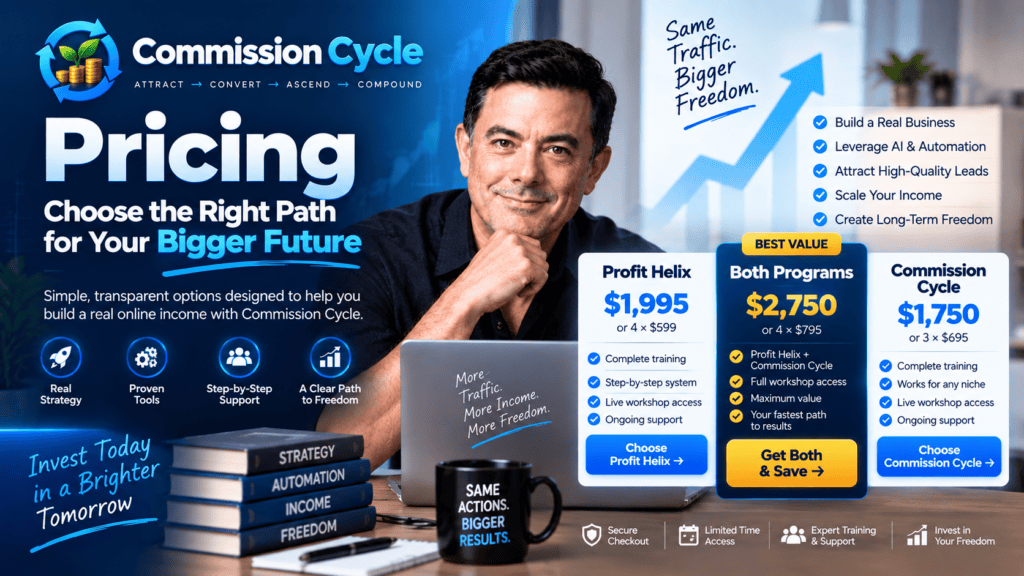
Commission Cycle is currently priced as a premium program.
| Payment Option | Price |
|---|---|
| Pay in Full | $2,497 |
| Payment Plan | 6 × $497 |
That price matters when evaluating the offer.
This isn’t a $27 beginner ebook that you buy just to see what happens.
At $2,497, I think potential customers should first understand:
- what the method actually teaches,
- whether they want to build an affiliate business,
- whether social traffic fits them,
- whether they will consistently implement the strategy,
- and whether the investment is comfortable for their current financial situation.
Training can shorten a learning curve.
Software can make execution faster.
Neither guarantees income.
Affiliate results depend on implementation, market conditions, traffic quality, offers, conversion rates and plenty of other variables.
Pricing and payment options can change. Confirm the current terms on the authorized Commission Cycle offer page before purchasing.
Who Is Behind Commission Cycle?
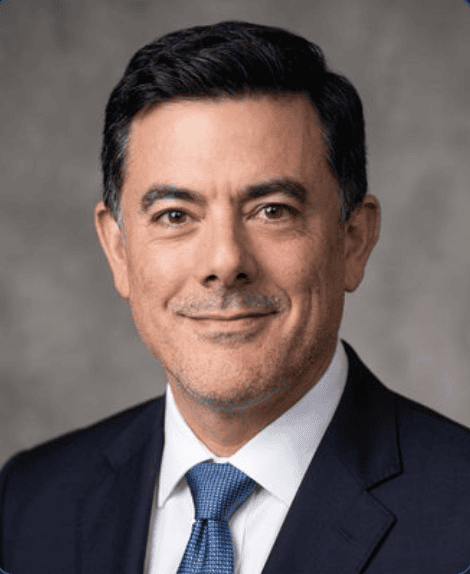
Mark Ling is the creator and primary teacher behind Commission Cycle.
His online marketing career dates back to 1999, giving him experience across several generations of internet traffic.
That’s relevant to the Commission Cycle philosophy.
Search traffic changed.
Google changed.
Facebook became important.
YouTube grew.
Instagram and short-form social media became major discovery channels.
Mark describes having worked through roughly seven traffic-source shifts during more than 26 years online.
But his core principle remained similar:
Make profitable sales, understand the economics of the business, and reinvest intelligently into growth.
Current promotional material also states that people Mark has taught have collectively generated more than $400 million in ClickBank sales.
That number needs context.
It is presented as a cumulative figure connected to people Mark has taught over his wider career. It should not be interpreted as typical Commission Cycle student earnings or as a promise that new students will achieve similar results.
That’s an important distinction.
Past sales figures can establish experience.
They cannot predict your income.
What Is Profit Engine Live?
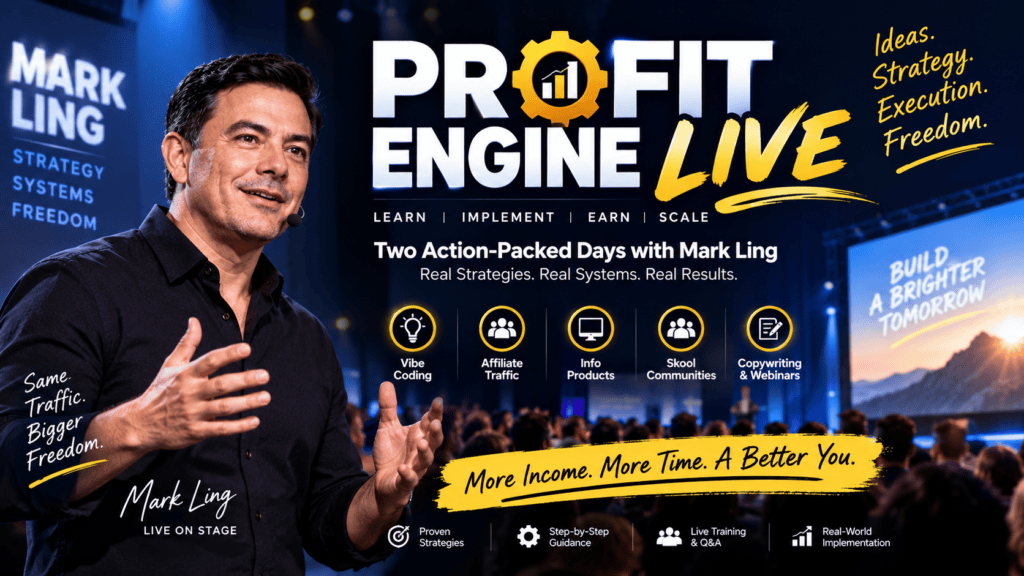
Profit Engine Live is Mark Ling’s free online event introducing many of the strategies surrounding Commission Cycle.
It is scheduled for Monday, September 14 and Tuesday, September 15, 2026.
Four different live sessions are planned across the two days.
Monday, September 14
3:00 PM Eastern — How to Get Paid from 1 Word Replies
This is the session where the Commission Cycle Method itself is revealed.
Topics include generating one-word replies, turning those responses into potential affiliate opportunities, and understanding the four numbers that influence profit.
8:00 PM Eastern — 27 Viral Post Templates That Turn Comments into Cash
This session focuses more heavily on creating posts designed to produce responses, including approaches intended for accounts without an established following.
Tuesday, September 15
3:00 PM Eastern — Secrets of a Super Affiliate Millionaire
A beginner-focused introduction to affiliate marketing, including how the business model works and the two markets Mark emphasizes.
8:00 PM Eastern — How to Start a 1 Person Digital Products Business in 2026
This session moves deeper into the AI and automation side of the strategy, including scripts, posts, research, videos and images.
The interesting part is that these are intended to be four different sessions, not one webinar repeated at four times.
That gives someone considering Commission Cycle a chance to learn quite a bit before deciding whether the full paid program makes sense.
What Is the Free Commission Cycle 2026 Report?
There’s also a free entry point for people who don’t want to begin with a live webinar.
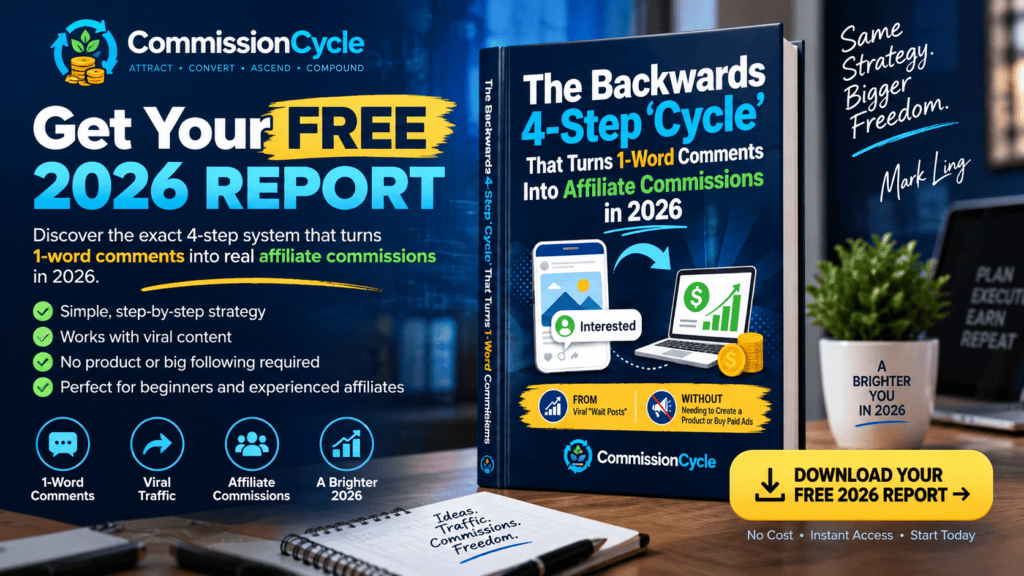
The report is called:
The Backwards 4-Step ‘Cycle’ That Turns 1-Word Comments Into Affiliate Commissions in 2026
It introduces the core thinking behind the Commission Cycle system.
Among the concepts covered are:
The Comment Loop Mechanic
This looks at using comments and interactions as part of the traffic mechanism instead of treating social engagement merely as a popularity metric.
The Self-Feeding Traffic Engine
The concept is that a short piece of content can contribute to the current conversion opportunity while also creating engagement that may help produce additional reach.
Hidden Buyers
Not everybody in an audience has only one interest.
Someone following personal development content, for example, may also be interested in building an online income stream.
Understanding overlapping interests can create additional affiliate opportunities when handled appropriately.
The Complete Four-Step Commission Cycle
Again, the framework is:
Attract → Convert → Ascend → Compound
AI-Assisted Execution
The report also introduces the role Mark’s automation tools play in reducing the amount of repetitive manual work involved.
If you’re completely new to the concept, I’d begin with the free material rather than trying to judge a $2,497 program from a sales page alone.
Who Is Commission Cycle For?
Commission Cycle may be worth investigating if you fit one or more of these situations.
You’re Starting Affiliate Marketing
You like the idea of earning by recommending products rather than building your own product from scratch.
The training starts with beginner-oriented material, so an established affiliate business isn’t a prerequisite.
You Already Make Occasional Affiliate Sales
Perhaps you can generate commissions but haven’t turned them into a predictable system.
The four-lever framework may be particularly relevant because it helps identify where growth is getting stuck.
You Want to Use Organic Social Traffic
The current strategy makes the most sense for somebody willing to use platforms such as Instagram and YouTube.
You’re a Solo Operator
The AI and automation tools are designed to reduce the amount of work that would otherwise need to be handled manually or outsourced.
You Don’t Have a Big Email List
Because social media provides the primary starting point, you don’t need to arrive with thousands of subscribers.
You can build a list alongside the strategy.
You’re Interested in Personal Development or MMO
Those are the two markets Mark particularly emphasizes in the current training.
Who Might Not Be a Good Fit?
Commission Cycle won’t suit everyone.
I’d think carefully before buying if:
- you have no interest in affiliate marketing,
- you don’t want to publish social content,
- you expect software to create income automatically,
- you’re looking for guaranteed returns,
- you’re unwilling to test and improve campaigns,
- you only want to build SEO websites,
- or $2,497 would put unnecessary pressure on your finances.
This deserves emphasis:
Commission Cycle is a business training system, not a guaranteed income system.
You still need execution.
A great hammer doesn’t build the house by itself.
The same applies to AI tools, templates and training.
Commission Cycle Method vs. Random Affiliate Marketing
Here’s a useful comparison.
| Random Approach | Commission Cycle Approach |
|---|---|
| Chase views | Generate measurable responses |
| Try random tactics | Work on defined business levers |
| Make a sale and start again | Reinvest part of commissions |
| Depend on one platform | Build around business economics |
| Do everything manually | Use AI and automation where useful |
| Promote once | Consider customer lifetime value |
| Focus only on traffic | Balance leads, conversion and customer value |
This doesn’t automatically make Commission Cycle successful for everyone.
What it does is give the strategy a more coherent structure than “post affiliate links and hope somebody buys.”
Is Commission Cycle Just Another Social Media Strategy?
No.
Social media is the current acquisition mechanism.
The Commission Cycle itself is broader.
That’s an important distinction because traffic platforms rarely stay dominant forever.
Mark’s career is a good example.
Different generations of marketers have relied on search engines, Google, Facebook, YouTube, Instagram and other channels.
The tactic changes.
The economics underneath a business change much less.
You still need people.
Some percentage needs to convert.
Each sale has a value.
Customers may purchase more than once.
And profit can be invested into growth.
That is the real Commission Cycle system.
Commission Cycle Official Website: Where Should You Go?
If you’re searching Google for the Commission Cycle official website, it’s important to distinguish between informational sites and Mark Ling’s authorized pages.
CommissionCycle.net is an independent informational and affiliate website.
It is not owned, operated or endorsed by Mark Ling or Commission Cycle.
The official product ecosystem uses CommissionCycle.com and its authorized registration, training and offer pages.
If you’re ready to explore the program, register for training or check current purchase terms, use an authorized link rather than assuming that any website containing the product name is official.
This is especially important with a premium product.
Before paying, check the current:
- price,
- payment options,
- terms,
- guarantee/refund information,
- bonuses,
- availability,
- and checkout details.
What I Like About the Commission Cycle Concept
The strongest part of the model, in my view, isn’t AI.
It isn’t Instagram either.
It’s the idea of thinking in cycles rather than campaigns.
Many beginners work like this:
Run tactic → get result → stop → find another tactic.
Commission Cycle encourages something closer to:
Run tactic → measure result → identify bottleneck → reinvest → improve → repeat.
That’s how an actual business owner thinks.
I also like the focus on responses instead of pure follower counts.
Ten thousand followers who ignore everything you publish aren’t necessarily more valuable than a much smaller audience that regularly tells you what it wants.
The emphasis on multiple profit levers is another strong point.
It stops “more traffic” from becoming the answer to every problem.
Sometimes traffic isn’t the problem.
What Should You Consider Before Joining?
There are also practical questions I’d ask before spending $2,497.
Will You Actually Use Social Media?
If the thought of publishing on Instagram or YouTube every week sounds unbearable, the current version of the system may clash with how you want to work.
Will You Implement What You Learn?
Premium training only makes economic sense when you use it.
Buying a course and watching 20% of it isn’t an investment strategy.
Are You Comfortable Promoting Other People’s Products?
That’s the foundation of affiliate marketing.
If you ultimately want to sell only your own products, another business model may be better aligned.
Can You Afford the Program Without Depending on Fast Results?
This matters.
Nobody can responsibly promise that you’ll immediately recover a $2,497 purchase through commissions.
Business results vary.
Join because the strategy fits your goals and resources, not because you feel pressured to “make the money back” quickly.
Commission Cycle FAQs
What is Commission Cycle?
Commission Cycle is Mark Ling’s 2026 affiliate marketing training system. It teaches students to generate affiliate opportunities through social traffic, convert interested prospects, increase customer value and reinvest part of commissions into further business growth.
Who created Commission Cycle?
Commission Cycle was created by longtime online marketer and affiliate educator Mark Ling, whose online marketing career dates back to 1999.
What is the Commission Cycle Method?
The Commission Cycle Method combines the four-stage framework Attract → Convert → Ascend → Compound with a profit model based on improving leads, conversions, average sale value and average number of sales per customer.
What is the Commission Cycle system?
The Commission Cycle system is the broader affiliate business model surrounding the method. It combines social traffic, one-word responses, affiliate offers, AI-assisted content creation, automation and profit reinvestment.
How much does Commission Cycle cost?
The current price is $2,497, with a payment option of 6 payments of $497. Always confirm current pricing and terms on the authorized offer page before purchasing.
Do I need my own product?
No. Commission Cycle focuses primarily on affiliate marketing, meaning you can promote products created by other companies and receive commissions when qualifying sales occur.
Do I need an email list?
An existing email list isn’t required to begin the core social traffic strategy. Mark nevertheless teaches list building because an owned audience can provide additional opportunities for growth.
Which traffic sources does Commission Cycle use?
The current training primarily emphasizes Instagram and YouTube, along with social engagement, resources and ManyChat automation.
Does Commission Cycle use AI?
Yes. Purpose-built AI tools are used to assist with tasks such as research, scripts, social content, videos and images.
Is Commission Cycle fully automated?
No. Automation and AI can reduce repetitive work, but the business still requires decisions, implementation, publishing, offer selection, analysis and optimization.
Is Commission Cycle suitable for beginners?
The training includes beginner-focused affiliate marketing material and does not require an existing product or large audience. Beginners should still expect a learning and implementation process.
What niches does Commission Cycle teach?
The two main niches emphasized are personal development and the make-money-online/internet marketing market.
What is Profit Engine Live?
Profit Engine Live is a free online training event from Mark Ling scheduled for September 14–15, 2026. Its four sessions cover one-word replies, social post templates, affiliate marketing and building a one-person digital business with automation tools.
Is there free Commission Cycle training?
Yes. Mark is offering both Profit Engine Live and a Free 2026 Report introducing the Backwards 4-Step Cycle.
What is the official Commission Cycle website?
The official product and training ecosystem uses CommissionCycle.com and its authorized pages. CommissionCycle.net is an independent informational/affiliate site and should not be confused with the official product website.
Does Commission Cycle guarantee that I will make money?
No legitimate affiliate marketing training can guarantee individual income. Results depend on factors including implementation, traffic, market selection, offers, conversion rates and business experience.
Final Thoughts on Commission Cycle
Commission Cycle arrives at an interesting moment in affiliate marketing.
Creating content has never been easier.
Getting attention, however, doesn’t automatically mean building a profitable business.
That’s the problem Mark Ling is attempting to address.
Rather than treating AI, Instagram, YouTube, affiliate products and automation as separate tactics, the Commission Cycle Method puts them inside a repeating framework:
Attract the right people.
Convert attention into customers.
Increase the value of those relationships.
Compound the results by reinvesting intelligently.
Then repeat.
For me, that’s the most important thing to understand before evaluating the program.
The one-word comment strategy may be what gets people’s attention.
The AI tools may make implementation faster.
But the real Commission Cycle system is the reinvestment loop underneath them.
If you want to see how Mark explains it himself before deciding whether a $2,497 program is right for you, start with the available free material.
There’s far more value in understanding the business model first than buying because of a headline.